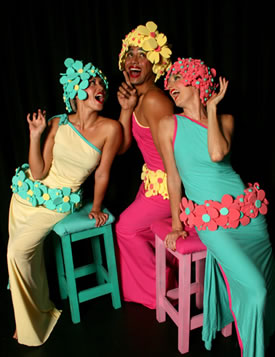
 Polytoxic is a Brisbane-based dance company that describes itself as “fusing traditional Polynesian, contemporary and street dance styles.” Teuila Postcards is their first full-length production and as is the nature of their other works, it is a celebration of popular culture and all its clichés. This particular show is also part of the Kultour program, which was established to increase awareness of Australian multicultural arts. In presenting Pacific culture not only through the often unobservant and ignorant eyes of the island’s tourists, this work takes its audience on an adventure far greater than that which they have come to expect from the glossy images of island life that abound.
The three members of Polytoxic are Efeso Fa’anana, Lisa Fa’alafi (both of Polynesian decent) and Leah Shelton (who the characters tease for being the first white Polynesian beauty). The trio not only perform, they have also designed and created the show. In terms of their performances, Fa’anana’s hip-hop flavoured movements complement Shelton’s precision and the more lyrical movements of Fa’alafi. Fa’anana has the most humorous and outlandish material with which to work. The scene in which he dances in drag and re-enacts Whitney Houston’s I’m Every Woman produces great laughter amongst the audience. The revelation that he is in fact playing a fa fafine, a Samoan boy who is not necessarily homosexual but is raised as a girl (which includes the teaching of good organisational skills for office work and household duties) gives a whole new meaning to this act.
The set, designed by Fa’alafi, is quite ingenious. It is a white wall with several square windows rather like an advent calendar and these open to offer glimpses of the performers or revolve to reveal a new feature on the otherwise plain wall. Cartoon images, film footage from the past and present, silhouettes, and definitions for Samoan words and phrases are also projected onto the wall.
Opening the show is the frantic dance of three tourists at the airport. Each, dressed formally in co-ordinating yellow and brown tartan outfits, is struggling to manoeuvre their own suitcase on wheels. In a demonstration of some intricate choreography the cases seem to have been accidentally mixed up, and as the travellers try to re-claim their own luggage, the cases appear to have a life of their own. In the course of the production and over the period of their holiday, we see the tourists only a handful of times; getting drunk in one of the island bars and when they are obtrusively taking photos of the locals.
In contrast to this are the three young Samoans. Here the performers play themselves (the Polytoxic ensemble) and they have visions for their future beyond that of performing domestic duties or their stage show for visitors at the island’s resort. When Fa’alafi’s (Lisa) discovers an ad in the local paper asking for Polynesian beauties and warriors to audition for starring roles in a television advertisement, the trio decide to audition. True to the promise behind the soft drink they are advertising, with one gulp they become the scantily clad, hyperactive and hyper-smiley people of the Pacific. In an effort to become successful they have had to become play up to the stereotypes that have been forced upon them.
Amidst all the colour and joviality of this work is the demonstrated presence and effect of Europeans or Caucasians on island life. To the Samoans they are known as Palagi and are very eloquently represented by the ‘mile-a-minute’, a weed-like vine that spreads quickly and profusely. It is projected in an image on the backdrop but is in the characters of the two European women that it is most effectively embodied. In this dance, Shelton and Fa’alafi’s limbs resemble tense and arthritic branches, themselves becoming the strangling vine.
The costumes, designed and created by Shelton and Fa’alafi are just another example of this company’s attention to detail. For the most part the costumes reflect the sense of fun, colour and liveliness of Samoa. In the drag scene the headgear, resembling oversized floral shower caps, makes quite a statement. The black hooped dresses and veils of the European women make them appear all the more obtrusive and vulgar, while in other scenes the costumes, in tandem with the music, reflect the mixture of tradition and popular culture on the island today.
When the excitement has passed Fa’alafi’s character, wearing a traditional sarong, goes back to sweeping with her hand-made straw broom. Duty and tradition will always be there but drowning out her mother’s orders is the music blaring out of her headphones. It is then that she is like any other young person. In Samoa too, “girls just wanna have fun.”
Teuila Postcards is one of those works that comes around once in a while to surprise its audience in so many wonderful ways. As is so often the case on holidays to an idyllic island or tropical destination, the tourists in this work leave with not much more than a hang over, a pair of cheap sunglasses, and few happy snaps. Its audience however will leave having been given an insight into the young adults of Samoa who despite the sunshine and the beach, are struggling to move away from the restrictions into which they were born; that of island life and a community steeped in tradition.
Arts House and Kultour presents
Teuila Postcards
Polytoxic
Venue: Arts House, North Melbourne Town Hall | 521 Queensberry St, North Melbourne
Dates: Wednesday 13 - Saturday 16 May
Time: 7.30pm
Tickets: $25 / $18
Bookings: www.artshouse.com.au or 03 9639 0096
Melbourne Reviews
Teuila Postcards | Polytoxic
- Details
- Penelope Broadbent
Most read Melbourne reviews

A Beautiful Noise – The Neil Diamond Musical
A Beautiful Noise is a jukebox musical that imagines present-day Diamond looking back on his history.
Pretty Woman The Musical
Adapting a beloved film with the cultural status of 1990s Pretty Woman is a huge creative swing.
Sweet Charity | Heirlume Productions
Heirlume’s production of Sweet Charity offers a fresh take on an iconic musical.
Keys to Life | Jayson Gillham & Iyad Sughayer
Two men, one tall one short, wearing suits with open-necked shirts, march on stage and turn a happy grin to the audience.
Pride & Prejudice* (*sort of) | Neil Gooding Productions & Woodward Productions
A nuanced and wild adaptation of one of the world’s most loved novels.
Spells, rules and the fourth wall are consistently broken in this chaotic retelling of some of the Grimm Brother’s most famous fairy tales.
A Beautiful Noise is a jukebox musical that imagines present-day Diamond looking back on his history.